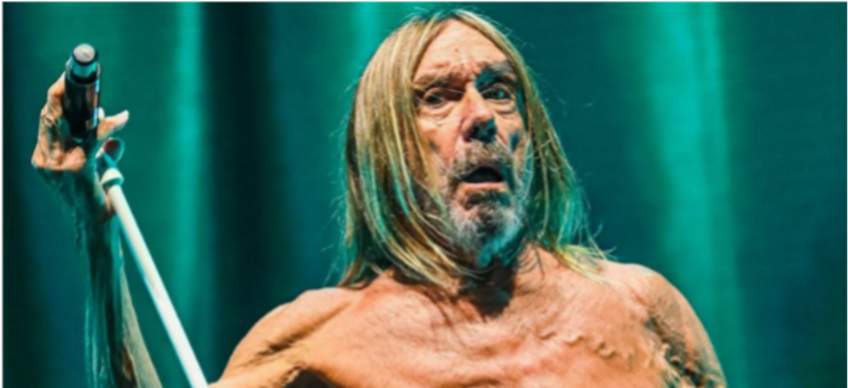
Let's say I'm talking about Iggy Pop
The year 2025 shuffled toward its own extinction. Without drama, it took that small leap on the calendar that infects us with the idea that every ending is a beginning. Biting into New Year's Eve grapes, one can feel a similar impulse: that of reinvention. I am not talking here about repairs to the shell of being, which only hide the passage of time. I am talking about that alchemy that unleashes new impulses, bursts of will, vectors of purpose, which sparkle inside the wrinkled nutshell, burnished by time and experience. The pendulum swing from rocker to balladeer resonates with me, from the placid sway of my Esquipulas hammock, as the embodiment of this concept, as the fascination of the established rocker with the path he never followed, with the life he never tried, and with the balladeer's feats that he only exercises on special occasions. Let's say I'm talking about Iggy Pop, master chameleon of punk rock, honeyed crooner, whose scandalous image has been on stage for six decades. Translated with DeepL.com (free version)
Wolf Man in Paris
In 2012, Iggy Pop dressed up in period court attire and set aside the stridency of rock to record the album Après, composed of hits in French by Georges Brassens, Edith Piaf, Serge Gainsbourg, Jacques Brel, and also in English, by the Beatles, Fred Neil, and others. Everything indicated that the hard rocker was moving away from explosive energy, self-mutilation on stage, and diving into the audience, toward calmness and romantic duets, unleashing a powerful, underground voice that moves listeners. A prime example is the song composed by Yoko Ono, “I'm Going Away Smiling.”
Angel of the underdogs
However, Iggy Pop wasn't ready to leave behind his dark persona and stories of the underground world, the revelation of urban nightmares that bourgeois comfort tries to ignore. With Strung Out Johnny, we gain empathy for the maturity and resilience that life demanded of Iggy to overcome his dark period of excess. In the late 1970s, he lost his band and almost lost his life. David Bowie offered him a fresh start in Berlin, to clean up, produce new albums together (The Idiot, Lust for Life), and tour Japan. With a piercing purr, Iggy's mature voice warns of the dangers of addiction in Strung Out Johnny, a scandalous piece of post-funk alternative rock included on his 2022 album Every Loser.
The one about the Pirata Cojo
The most surprising facet of Iggy Pop is his acting. With credits in more than fifty films and one more in development, he has created memorable characters. Sometimes they are brief appearances or performances of himself (in a comical way). In 1993, acclaimed director Jim Jarmusch (Gimme Danger, The Dead Don't Die) invited him to co-star with Tom Waits in the short film Coffee and Cigarettes III. With this short film, Jarmusch won the Palme d'Or at Cannes for his genius in bringing together two legends around a coffee table, celebrating with coffee and cigarettes the freedom that finally kicking the habit represents.
I did everything, without restraint./h2>
Life experience and physical appearance are valuable assets for embodying dark characters, such as junkies, zombies or gunmen, for lending his voice to animated characters – or their conscience – and as a star in music videos directed by David Fincher, Sam Raimi or Paula Graif. His voice elevates iconic characters in video games such as Grand Theft Auto and Driv3r. Iggy Pop's musical genius has helped set the tone for the most intense films, through songs that have ended up on film soundtracks (389 in total!), 23 of which were composed exclusively for those films. Iggy Pop (James Newell Osterberg Jr.) exploits for film and television the traits of Danish, Norwegian, Swedish, German, English and Irish ancestry, typical of the melting pot of Muskegon, Michigan, one of the first habitable places at the end of the Ice Age, a magnet for fur trappers during the colonisation of the Great Lakes, and for the World Capital of Lumber in the 19th century; the destination of European migrants during the First and Second World Wars, and in the failed industrial projects of the 1950s and 1960s. In The Crow: City of Angels, Iggy Pop plays Curve, a punk-looking villain who manages to make himself hated in just two and a half minutes.
Don't blame the beach
In 1993, Iggy performed at the Obras Sanitarias stadium and in a more intimate and private venue, the Club Prix d'Ami. There he met Alejandra Carrizo, with whom he fell in love and remained in a relationship for five years. In 1999, the love story came to an end, and from this separation sprang ‘Miss Argentina’, a song of love and heartbreak, devotion and farewell. Sitting and playing an acoustic guitar, Iggy admits that Alejandra's luminous humanity rescued his spirit, imparting sensitivity and a rejection of darker games - a reference to the abstinence he would later show during his relationship with Liliana Mora, the Colombian woman who restored his balance during 18 months of empanadas and rest, films and fried chicken from street vendors, between Miami and Bogotá.
A fondness for... jazz
It's not easy to step into the shoes of a crooner with a soul jazz song, but Iggy Pop soared on Dr. Lonnie Smith's (1942-2021) album ‘Breathe’ as the performer of ‘Why Can't We Live Together’. The hypnotic, deep timbre of Iggy Pop's smooth voice conveys the emotion of the impact of war. In 1972, when Timmy Thomas wrote the song, it was about the Vietnam War. Lonnie Smith was a jazz organist who had been making high-quality music since the 1960s, when he was part of George Benson's quartet, and later created his own band. In collaboration with Jonathan Kreisberg, Lonnie Smith's organ and Iggy Pop's voice created a rhythmic and melodic complicity between funk rock and cosmic funk jazz. The music editor wisely chose to keep the rocker's cavernous laugh and pleased ‘naaaiisss’ at the end of the track.
Do you want it darker?
In ‘Free’, Iggy Pop's eighteenth album, released in 2019, he included a song with several nuances that are important to our conjecture. Iggy is creating a fusion between melodic song and punk theme, focusing on the darker themes of his musical journey, but revealing an expressive sensitivity on the twilight border of optimism. Ale Campos, the Argentine-Cuban guitarist who also appears in the music video for this song, began covering for him by accident and, despite having her own band (Las Nubes), accompanies Iggy on his tours and, more recently, at the massive September 2025 show at the Moviestar Arena in Buenos Aires. There was the monumental Iggy, once again shirtless, once again with his scoliosis on display, and with an endless, dense repertoire that, at 78 years of age, is a declaration of rebellion, a lustful desire to live.
We are all transient.
The central point of this journey is to show that it is possible, and sometimes even urgent, to open the saddlebags of life and review our qualities and abilities, the potential we have not explored, and dare to renew, reinvent, and take a leap of faith. With a deforming scoliosis and one leg four centimeters shorter than the other, with a lot of anger inside and almost living on the streets of Los Angeles, Iggy Pop climbed out of the pit and learned to live in a permanent state of transition, exploration, and relevance. Inspiring young people of all ages, he gave his all at the concert in Germany. And if doing is the best way to say it, how much does Iggy Pop tell us about the beauty of an inner stoicism and the outer exuberance of this constant traveler?

By: Ricardo Dajalma Valladares Cardona
Guest columnist